Reviewed by Phillip J Gray
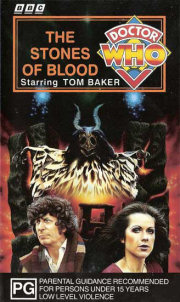
The Doctor and Romana fit together the first two segments of the Key to Time
before arriving at their next destination, Cornwall on contemporary Earth. In
their quest for the third segment they are drawn into an adventure involving
modern-day druids worshipping at a stone circle, a Celtic goddess, an eccentric
archaeologist, and a spaceship stalled in hyperspace...
'The universe is in danger of eternal chaos.'
Script and the balance between plot and sub-plot
David Fisher's script is a good storyline with a minimal number of
characters, allowing for their greater development as individuals. It is always
difficult when considering stories produced in the late Seventies to know
whether a script is good per se or because of the finesse of the script editor
and the embellishments made by Tom Baker, but even Tom Baker could only produce
wit from scenes with good dialogue to start with. It is appropriate, then, to
judge the script to be a good one; certainly there are some marvellous lines
for the main characters and the bureaucratically-blinded Megara, although there
is also rather more technobabble than is usual in a story of this period,
thankfully interspersed with some witty line deliveries from Tom Baker: 'Run as
if something very nasty were after you, because something very nasty will be
after you!' he tells a concerned Professor Rumford when she asks what to do if
the Ogri arrive.
The six stories which make up the Key to Time sequence need to be judged
both on their merits as a story (the plot), and for their contribution in the
overall thematic sequence. The threads of the quest in The Stones of Blood are
handled very well. Unlike The Trial of a Time Lord some eight years
later, when the series attempted to repeat the same experiment, the threads of
subplot are not only used successfully to encircle the beginning and ending of
the story, but also run relatively unobtrusively through the narrative as a
whole. At the same time, and this comes about through a combination of
excellent scripting, script editing and acting, the subplot is not allowed to
weaken the storyline. The first five minutes are spent introducing/reintroducing
the audience to the ongoing theme of the search for the segments to the Key to
Time. Given that this is the first contact with the casual viewer and is
designed to 'hook' them into staying for the full twenty-five minutes, this is
a particularly significant move on the writer/script editor's part. It
demonstrates their commitment to the season's theme: the opening minutes of the
story are, after all, a substantial chunk of narrative which might otherwise be
spent introducing the viewer to the setting and characters.
The quest is painted in broad enough strokes, with references to Black and
White Guardians and the Doctor's apocalyptic mutterings, while the fact that
Romana was unaware of the true identity of the being who launched her on her
travels with the Doctor and the reference early in the first episode back to
the events of Calufrax in the previous story are presented to followers of the
season as a whole. While the formal quest in The Stones of Blood is
sublimated by the events at the stone circle and the Doctor's engagement with
the Megara, he refers to it in the course of the trial and there are constant
references to the fact that the Doctor and Romana are looking for something.
The viewer is presented with a number of objects which might or might not be
the third segment and is encouraged to believe both by the setting and the
story title that one of the megalithic stones is the segment. As the Doctor and
Romana become caught up in events the quest becomes submerged in the scenes
around the circle and in the spaceship in hyperspace, but obvious clues are
left for the viewer to piece together, and for the less investigative viewer,
the Doctor and Romana often explain what is happening. This is why The Stones
of Blood and the other stories of the season are much more successful than
The Trial of a Time Lord: events are constantly explained both overtly
and more subtly to the viewer. Romana and the Doctor realise that whoever
attacked her disguised as the Doctor must have figured out how to use the
segment's transmutative properties. And as the major plot is resolved with the
apprehension of Cessair, the subplot emerges with the revelation that the Seal
wielded by Vivien Fay/Cessair is capable of bestowing powers of transmutation,
justifying the Doctor's recovery of the seal as Cessair taunts him moments
before her own final transformation. The final scene in the TARDIS anteroom not
only illustrates the Doctor and Romana's achievement with the fitting together
of the three segments, but renders the story an enclosed entity by rounding it
off in preparation for their next destination.
'I always thought that Druidism was founded by John Aubrey in the seventeenth century as a joke...'
Establishing the pseudo-Celtic setting
The setting is established immediately through the opening scenes with the
banter between the protagonists about Earth being the Doctor's favourite
planet, but also with the sacrificial ceremony accompanied by fairly blatant
chanting. This clearly establishes the pseudo-Celtic background and setting,
with the initial scenes at the stone circle introducing the enjoyably pastiche
themes of Celtic mythology and archaeology in which the story is set. The
Seventies was the era of the theories of van Daniken, in which gods were aliens
and lost civilisations possessed advanced technology, and The Stones of Blood
fits neatly into this genre. Moreover the characters act as channels of
information about the setting while also didactically introducing details in an
enjoyable and unobtrusive fashion. The Doctor tells Romana that the monoliths
were used for astrological purposes by early humans in the first episode, and
further information about the nature of the mystical Celtic places of Great
Britain are revealed in later scenes, particularly when Romana, Emilia and
Vivien are in Miss Fay's cottage. This perpetuates the mythical atmosphere
present in the story, something assisted by the main question directed at the
viewer: who or what is the Cailleach, and why are they posing as a four
thousand year old Celtic goddess?
'I think you should advise your client that there is little chance of mercy.'
From Celtic escapades to Crown Court in space
As Howe, Stammers and Walker note in The Fourth Doctor Handbook, there is a
fairly abrupt change in the nature of The Stones of Blood, with the transfer of
several of the major characters to the spaceship in hyperspace in the third
episode.1 The initial amusement generated
by the Megara and their legalistic dialogue tires, although these scenes allow
Tom Baker to demonstrate his theatricality in the previously unseen role of
advocate, through a mixture of righteous indignation and sharpness of thought.
There is some snappy and thought-provoking dialogue, such as the Megara's
response to Vivien Fay's attachment to the truth ray: 'an answer within the
legal definition of truth'. But compared with the darkened locations and
suspenseful events of previous episodes, these scenes come across as rather
flat and tedious. This viewer found himself much more interested in the
relationship between K9 and Emilia Rumford guarding the Doctor's machine at the
stone circle. John Stout's designs for the spaceship in hyperspace are, it has
to be said, nothing spectacular, consisting of grey corridors with little
obvious attempt at originality. The control chamber is better: the open space
is a valuable arena for the confrontation between the Megara and the Doctor in
the final two episodes, and allows for the expression of Tom Baker's
physicality, such as his pacing up and down before delivering another verbal
blow in the judicial fray. The expanse of the set also allows for the
simultaneous presence and distancing from the proceedings of the villainess;
Vivien Fay is able to both comment on and draw back from the Doctor's
predicament. It is strange for the viewer to be able to watch Miss Fay sit by
while the Doctor is interrogated by the officious Megara. In fact, the
denouement to the story is one in which the Doctor does not contribute
significantly to her apprehension at all. Although he does force the Megara to
enter Miss Fay's mind to discover that she is the criminal Cessair of Diplos,
it is the justice machines that destroy one of the Ogri, return the party to
Earth and imprison Miss Fay with more than a measure of poetic justice.
'Well, you know how it is, Professor, I often get tied up in my work...'
The underscoring of tension with humour
I have argued elsewhere that the use of wit was a major feature in Doctor
Who's successful underscoring of both implied and real violence in the
Seventies.2 There are many examples of this
technique in The Stones of Blood, both of visual and verbal wit. These
serve both to entertain and to defuse tension: the umbrella over the head scene
when the Doctor leaves the TARDIS, for example, or the Doctor's covering K9's
'eyes' in Part Three when about to examine the body of de Vries. The
metaphorical protection the latter demonstrates is a hint to the viewer that
something less than pleasant is about to happen and indeed the Doctor's next
words are that de Vries is 'Dead. Skull smashed to pulp.' The verbal and
physical wit in the story never distract from the plot or threaten the
integrity of the lead characters and contribute significantly to the
understated menace present throughout the story.
'Vivien and I are conducting a piece of genuine scholastic research.'
Interesting and credible female characters come to the fore
Characterisation is one of the most interesting and entertaining features of
The Stones of Blood. The relationship between the Doctor and Romana is
firmly established in the opening scene. Tom Baker is his archetypal self of
the late seventies: confident, authoritative, witty and entertaining. Romana is
a cool and self-confident associate of the Doctor. I say associate, rather than
companion, because Mary Tamm injects a degree of self-confidence into the first
incarnation of Romana which transcends most of the limitations built into the
character as a plot device. But the Doctor is the hero, so while it is the
assistant who fits the pieces of crystal together it is the Doctor who
reasserts his dominant position within their relationship. Romana's cleverness
is accompanied by a demonstration of a degree of impracticality, manifested as
frivolity. The viewer is aware that her choice of heeled courts as footwear is
probably going to be inappropriate, something confirmed a short time later.
Note also that when Romana returns to change her shoes later in the story she
also changes her whole outfit! (Speaking of clothes, I would like here to
express my undying devotion to the gorgeous pink trouser suit worn by Vivien
Fay in the first two episodes!) Romana's naiveté is a useful device for the
dissemination of humour - the tennis and Brown Owl references, for example -
and also for the introduction of plot elements which alert the attention of the
audience, such as the marks in the ground near the stone circle. Although
Romana can easily surmise through scientific methods that these were caused by
something weighing over three and a half tons, the viewer and the Doctor know,
though she does not, that there are no animals in England heavy enough to make
such indentations. The other companion is one whom many have no time for; but
K9 works very well in this story. He is as wonderfully insufferable as ever
(witness the 'noble self-sacrifice scene' when damaged by the Ogri at de Vries'
house), and his partnership with Emilia Rumford is never less than enjoyable,
the smug automaton and the elderly archaeologist working very well together.
Beatrix Lehmann's portrayal of Emilia Rumford is brilliant, and like Sylvia
Coleridge before her she would have been a marvellous companion. Whether riding
to the Doctor's rescue on her bicycle, munching sausage sandwiches or teamed up
with the Doctor and K9 and operating the Doctor's device for travelling into
hyperspace, she is a constantly entertaining yet credible eccentric. The
lovable nature imbued by Beatrix Lehmann's performance adds layers to the
character. But unlike so many characters in Doctor Who, we learn that she has a
life outside of the narrow confines of the storyline. It is revealed to the
viewer that she is a qualified and respected archaeologist who has lectured in
New York and is concerned for her academic reputation; this can only enhance
the credibility of the character. Susan Engel is excellent as the creepy Miss
Fay, giving a performance reminiscent of Eleanor Bron at some points. For the
first time a character in the search for one of the segments knows how to use
its properties, in this case the power to transform objects into the appearance
of something or someone else. But the character seems a little motivationless.
Surely she would have had many such opportunities to leave in the four thousand
or so years since she escaped from the spaceship to Earth? The character seems
to lose direction further having revealed herself to be Cessair of Diplos,
although there are some good scenes when she despatches Romana to the spaceship
and when she confronts Emilia and destroys the Doctor's device for hyperspatial
travel. Perhaps this loss of focus is because she spends most of the final two
episodes waiting around while the Doctor conducts his defence against the
execution verdict delivered by the Megara. Delaying the revelation of Vivien
Fay's true identity until the conclusion of the third episode would have been
more satisfying.
![[Vivien Fay]](g/vivienfaym.jpg)
Professor Rumford's constant use of the refrain 'girls', the initial
pairings of Emilia and Vivien and the subsequent partnerships of Romana and
Emilia, and Romana and Vivien confirm the sisterly nature of the story. These
combinations work extremely well together; in the third episode Mary Tamm is
given the opportunity to take the role of the Doctor and Emilia Rumford becomes
the assistant as they search Vivien Fay's cottage for any hint of her alien
nature. The fact that the major characters are almost exclusively women is what
really makes The Stones of Blood stand out among Doctor Who
stories. At first the main character seems to be de Vries (played just this
side of OTT by Nicholas McArdle), who occupies the large house and is the
leader of the druid worshippers. He dominates the beginning of the story while
Romana, Professor Rumford and Vivien Fay are only in the background; the viewer
initially has little reason to believe that they are going to perform more than
the decorative function of many of the women characters in the series. But the
Tom Baker era is unique among the seven Doctors for the presence of strong and
credible women characters: Adrasta, Miss Winters, Vira and Amelia Ducat, to
name a few. Notice how de Vries' presence is effectively removed by the middle
of the second episode, while his death by one of the Ogri summoned by the
'goddess' he worshipped further reinforces the female presence. The women
characters in The Stones of Blood not only occupy the present but also the
mythological and the real past. Vivien Fay is the Cailleach, and as the Doctor
tells Emilia at the beginning of the third episode, her friend is not merely
related to the women in the paintings, but that she is the Montcalm and the
Trefusis families. Vivien Fay has masqueraded as a Celtic goddess to control
access to the stones for nearly four thousand years, a reversal of the norms of
power relationships both in society and the usual in Doctor Who.
'Beware the raven and the crow. They are her servants.'
Direction, location filming and atmospheric touches
This is the only Doctor Who story directed by Darrol Blake, the
series being the worse for his never returning. Blake has a real feel for the
location filming, the final product having a much more polished look than the
usual jumpy studio/location production. The simulated night filming (using a
dark filter) is impressive, avoiding the tacky brightness which plagued many
stories in the Eighties. The story benefits enormously in the first three
episodes from the constant flow of action between the stone circle, the TARDIS,
Vivien Fay's cottage and the spaceship. One really gets the feeling that the
TARDIS is more than simply a machine for time travel when the Doctor and Romana
return to it on various occasions to change clothes or to fetch equipment. The
sets for Miss Fay's cottage and de Vries' house are excellent and are much more
evocative than the usual studio sets. The direction of the studio sequences is
more workmanlike, although there is a good shot of the spaceship model in
hyperspace where one can see Tom Baker on the inside looking out.
The excellence and subtlety of Darrol Blake's direction is perhaps best
demonstrated in the ways in which he builds the viewer up to the gradual
realisation that Vivien Fay is the villainess. The character's introduction is
accompanied by a threatening thrust of measuring equipment into the ground, the
Doctor remarking that she arrived in almost complete silence. The camera
lingers on Susan Engel, last among the party to leave the stones, and there is
a sting of incidental music which hints that there is rather more than there
seems to Miss Fay. When Vivien destroys the Doctor's machine and summons the
Ogri there is a striking close-up on Engel, complete with overlaid effects,
which adds much to the scene as she stares out from the screen at the viewer.
There are also some wonderful little directorial touches: the Hitchcock-like
scene when Romana leaves the TARDIS and senses the raven on the roof behind her
both emphasises her own alienness and admirably reinforces the Celtic atmosphere.
'How do you kill a stone?'
Monsters and music
The Ogri are probably the most credible of monsters in the sixteenth season,
given that they are neither just plain bad as in The Ribos Operation, or
brilliantly crap, as with the monster in the first part of The Androids of
Tara (also written, of course, by David Fisher). The scenes where an Ogri
smashes down doors to get into de Vries' house are rather more impressive than
K9 holding them off at the stone circle. They work best as a 'concept' monster;
that of blood-sucking aliens disguised as megalithic stones, as demonstrated in
the scene where they kill the campers.
As for music, I must confess that this is not a feature I notice especially
in Doctor Who. The best incidental music is, of course, the kind which
does not draw attention to itself away from the narrative. The incidentals for
The Stones of Blood are fairly standard Dudley Simpson fare, pleasant
enough in their own way and nothing startlingly inappropriate. There is a nice
cello interlude which accompanies the Doctor walking across the field towards
de Vries' house in the second episode and some pleasant woodwind later in the
story. Also effective is the 'bull-fighting' music used when the Doctor lures
one of the Ogri over the cliff top in Part Three and the sucking sound used to
denote their approach and presence.
But a few weak points
These ought not to be dwelt upon at the expense of so much that is good. The
cliffhangers are not particularly impressive; although that between the first
two episodes is handled with some sensitivity and hints that there is still
some distrust between the two Time Lords. The impressiveness of the scene where
Mary Tamm is CSO'ed onto stock footage of a cliff face and waves dashing
against rocks diminishes with its frequency (and I would be willing to bet that
the footage was taken from Poldark!) Susan Engel's silly silver make-up when
she transforms into Cessair detracts from her credibility as an intergalactic
criminal by making her look like something out of Lost in Space, and it
restricts her facial expressions and distracts attention away from Miss Engel's
smouldering dark eyes.
Conclusion
Not only is The Stones of Blood a suspenseful and entertaining story
in its own right, with interesting characters and a good balance of wit and
danger, but it also admirably demonstrates that there is room for a thematic
sequence in a Doctor Who season if the relationship between the primary and
subplots are handled correctly and if the primary plot is a strong story in its
own right. The references to the quest for the Key to Time are present and are
reinforced overtly at the beginning and end of the story and more subtly
throughout, without distracting from the progress of the events at hand. Darrol
Blake's direction is skilful and evocative and the acting cannot be faulted,
making The Stones of Blood an excellent example of Doctor Who at
its best.
Footnotes
- Howe, Stammers and Walker, The Fourth Doctor Handbook, p109.
- Why the Nimon Should be our Friends. Storytelling and Stylistic Change in Doctor Who, TSV 41, p29-33.
